Rob Fullwood has worked for Filtermist for more than five years and took on the role of Field Engineering Manager back in June. Rob is now responsible for overseeing all of our field engineers and contractors that undertake LEV testing, servicing and maintenance on dust extraction systems, fume extraction units and oil mist filters throughout the UK.
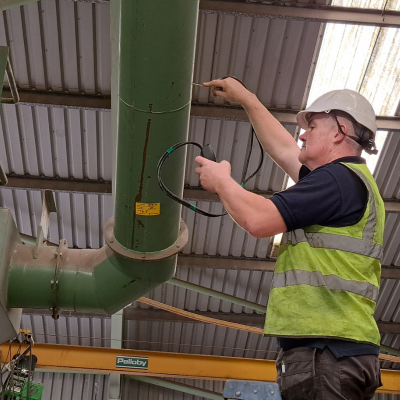
“We currently have 26 field engineers in our aftermarket department, as well as ten installation engineers,” says Rob. “Our team works right across Great Britain on all makes and models of LEV system and it’s my job to ensure that we are delivering a first-class service to all of our customers.”
Rob has more than 35 years’ experience in the dust and fume extraction industry. He started his career as a sheet metal worker before moving into systems installation and then COSHH (Control of Substances Hazardous to Health) compliance. Rob has run his own extraction installation businesses and holds P601 and P604 qualifications.
“Our industry is extremely competitive – there are a lot of local exhaust ventilation (LEV) systems in daily use across the country and every single one of them needs to be regularly serviced and tested in order to comply with COSHH Regulations,” continues Rob. “The HSE takes this issue very seriously – the latest statistics still show that around 12,000 deaths in Great Britain every year are linked to past occupational exposures.
“A series of recent HSE inspection programmes have focussed on the use of LEV systems to effectively control contaminants including mist from metalworking fluids, welding fume, silica dust, woodworking dust and flour. All of these airborne particles can pose a risk to human health if breathed in.”
COSHH Regulations, part of the Health and Safety at Work Act 1974, require all employers to protect employees from any substances that may cause health issues. If substances can’t be eliminated from a process or substituted with a safer alternative, the HSE’s hierarchy of controls advises using Engineering controls to minimise risk to ‘as low as reasonably practicable’ (ALARP).
All manufacturers of LEV equipment, and companies that offer supporting services such as LEV testing, are advised to adhere to the HSE’s HSG258 guidelines to ensure the service they are delivering complies with COSHH requirements. The HSG258 publication, titled ‘controlling airborne contaminants at work – a guide to local exhaust ventilation’, details how a thorough examination and test (TExT) should be carried out, what the HSE means by ‘a competent person’, how often LEV systems should be tested and what should be included in the test report.
“There have been recent cases of the HSE intervening when it feels an LEV Testing company has failed to provide adequate advice and information that would have enabled its customers to effectively protect employees from exposure to hazardous airborne substances,” continues Rob. “We provide a summary sheet of all systems which have been tested, as well as detailed test reports for each individual system. If the engineer feels improvements could be made to the LEV system, these are included in the report to allow the customer to make an informed decision on whether their existing control measures are fit for purpose.”
The dedicated LEV Testing page on Filtermist’s UK website includes details of the test method employed by Filtermist LEV engineers for customers throughout the UK – find out more by following this link.